When thinking of Louise Brooks (1906–1985) images of the ultimate 1920s flapper instantly come to mind: the razor-sharp bob, the defiant gaze, and her legendary roles in G.W. Pabst’s Weimar masterpieces Die Büchse der Pandora and Tagebuch einer Verlorenen. However, before she redefined European cinema, Brooks was under contract with Paramount Pictures, where studio photographers constantly pushed the boundaries of theatrical and exotic publicity portraiture.
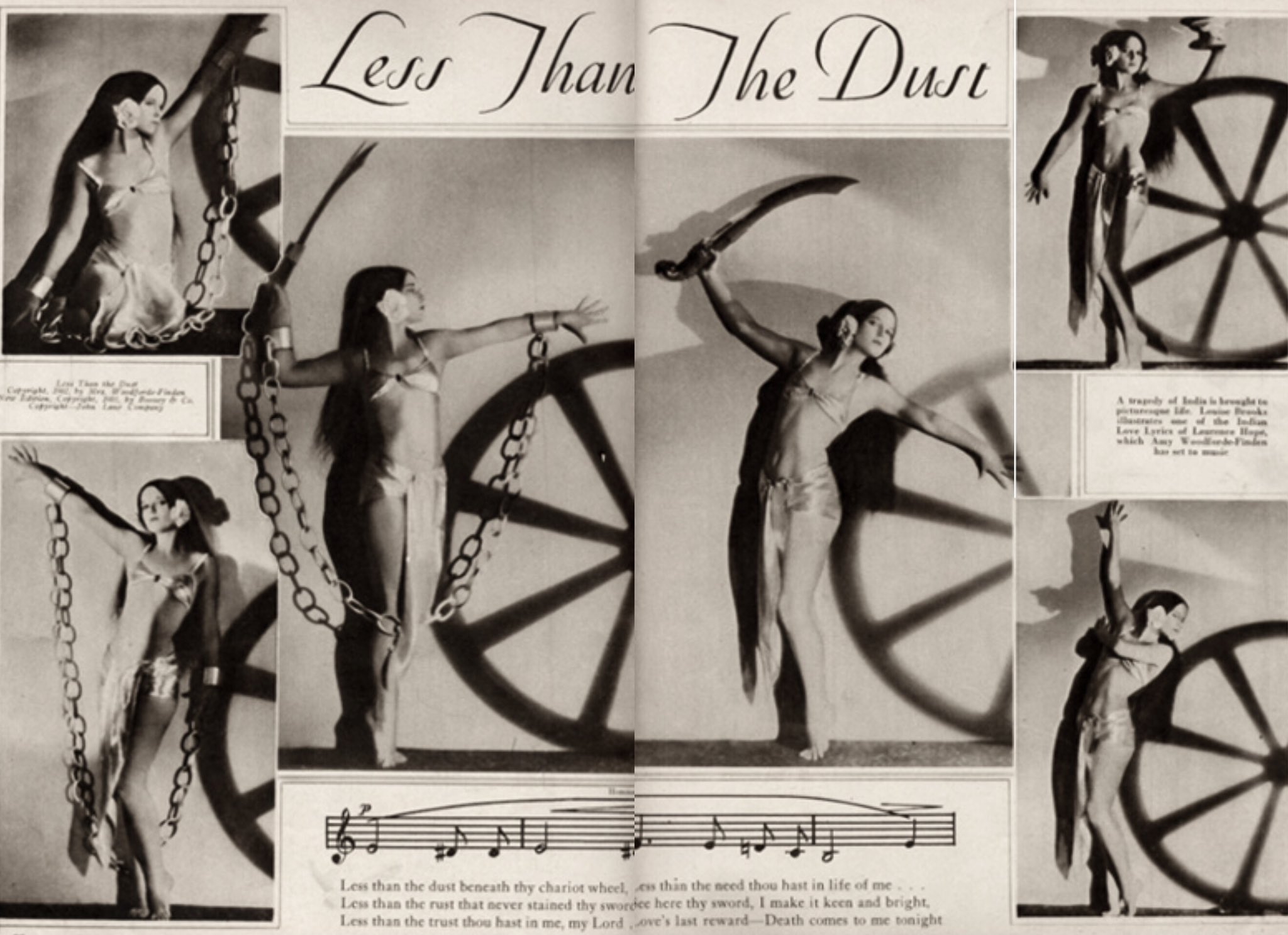
A remarkable and lesser-known archival discovery highlights this perfectly: a striking, highly stylized 1928 photo session shot by Paramount studio photographer George P. Hommel (1901 – 1953).
The Aesthetic of Captivity: Chains, Wheels, and Sabers
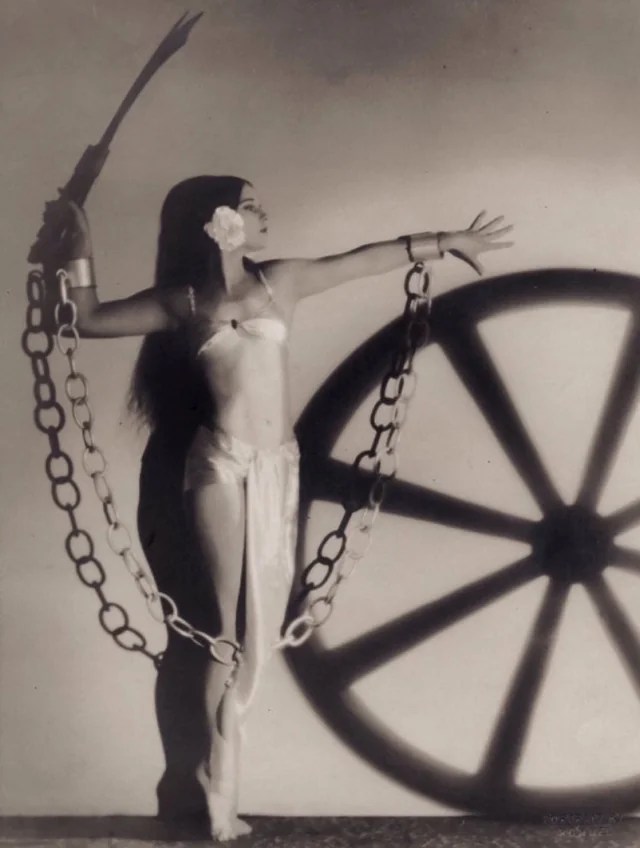
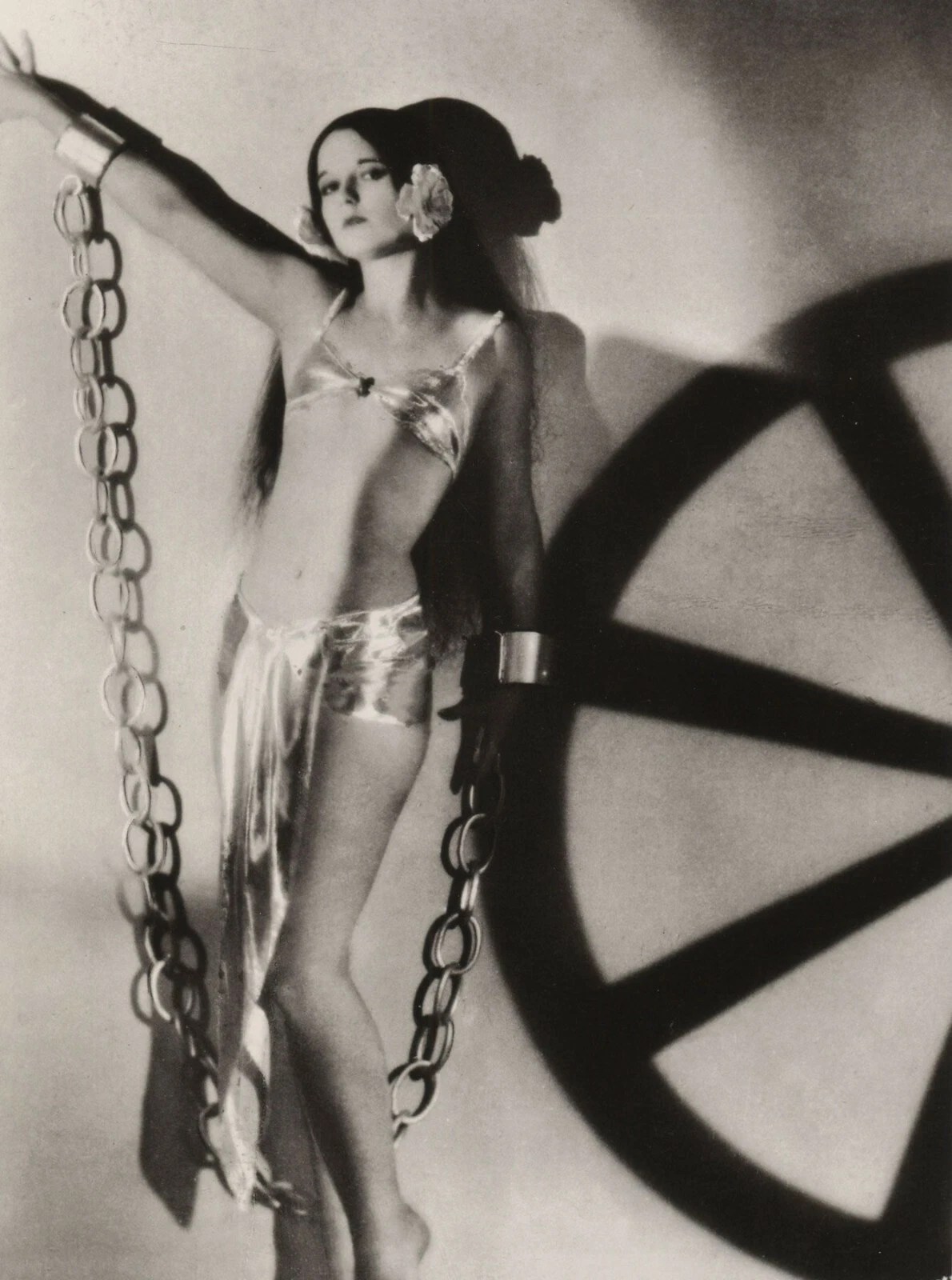
In this specific series, Brooks trades her modern flapper attire for a minimalist, theatrical “harem girl” costume. What makes this shoot fascinating for this archive is its heavy reliance on classic motifs of captivity and submission.
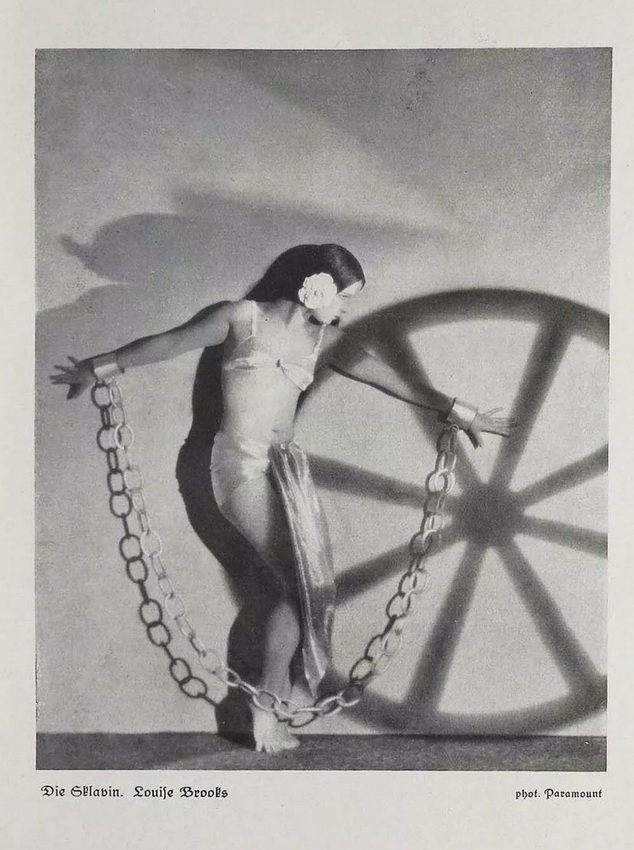
Brooks is draped in heavy, oversized theatrical chains attached to wide metal cuffs around her wrists. The staging utilizes dramatic, high-contrast Art Deco shadow play. Prominently cast against the background wall is the massive silhouette of a chariot wheel, evoking a sense of being bound to a wheel of fortune or a historical device of torment. In a few of the more dynamic frames, Brooks wields a curved eastern saber, adding a fierce, defiant edge to the otherwise submissive aesthetic.
From Indian Poetry to European “Sklavin”
While modern eyes immediately recognize the heavy BDSM and bondage undertones of the imagery, the official mainstream framing in 1928 was purely literary. The shoot was published as a prominent spread in Motion Picture Magazine to illustrate “Less Than the Dust,” a wildly popular 1902 poem from the Indian Love Lyrics written by Laurence Hope (Adela Florence Nicolson).
The lyrics printed alongside the sheet music on the original pages perfectly explain the choice of props:
Less than the dust beneath thy chariot wheel…
Laurence Hope
Less than the rust that never stained thy sword…
While American audiences viewed it through the fashionable lens of 1920s Orientalism, European distributors leaned much harder into the underlying erotic power dynamics. In Germany, prints of these exact Paramount studio portraits were distributed under the direct and provocative title “Die Sklavin” (The Slave), cementing Brooks’ image as an icon of exotic captivation.
Reconstructing the Complete Session
Thanks to recent archival findings, it is now possible to examine the complete magazine spread alongside individual high-resolution prints of the session, including rare hand-colored variations distributed in Italy. The session yielded at least seven distinct poses, showcasing Brooks as she transitions from a vulnerable, bound captive leaning against the studio wall to a striking, blade-wielding heroine.
This session remains a stellar historical example of how early Hollywood walked the fine line between mainstream artistic publicity and dark, fetishistic romanticism.


Recommended & Sources
Forever Louise Brooks on X
Great find!!!!!!!