When searching for spanking art, one occasionally stumbles upon a curious motif that keeps returning: the spanking machine. While most examples appear in fiction and illustration, the idea of a mechanical device that could deliver corporal punishment with precision has a longer and stranger history than many realize. This post explores the early documented references to such machines, from philosophical proposals to newspaper reports and actual patented devices.
Early Ideas: Jeremy Bentham
One of the earliest serious proposals came from the utilitarian philosopher Jeremy Bentham. In The Rationale of Punishment (1830) he wrote:
A machine might be made, which should put in motion certain elastic rods of cane or whalebone, the number and size of which might be determined by the law: the body of the delinquent might be subjected to the strokes of these rods, and the force and rapidity with which they should be applied, might be prescribed by the Judge: thus everything which is arbitrary might be removed
Jeremy Bentham – The Rationale of Punishment (1830)
Bentham’s concern was consistency. Human executioners, he argued, were too unpredictable. A machine would remove personal whim from the equation.


1859 – The Steam-Powered Flogging Machine
In September 1859, following a particularly brutal military flogging at Woolwich in which twenty-one men fainted, the British satirical magazine Punch published a piece titled “The Steam Cat” (17 September 1859). It proposed a steam-driven flogging machine capable of precisely regulating the force of each stroke, from a mild correction to enough power “to lay bare the ribs and dorsal vertebrae of a muscular grenadier at one stroke.” Though written as satire, the article shows how the idea of mechanical punishment was already circulating in public discussion.
Minnesota State Training School, Red Wing (1903)
One of the few documented cases of an actual device in institutional use comes from the Minnesota State Training School in Red Wing. In October 1903 several American newspapers, including the Star Tribune and the Sunday Oregonian, reported that a “spanking machine” had been introduced at the school.
A South Tyrolean paper, the Pustertaler Bote, even carried the story under the headline “Die Prügelmaschine.”
According to later official investigations (1911), the apparatus was used between 1903 and 1905. Boys were secured over a frame with their feet and wrists fastened; a wet towel was sometimes placed over the bare buttocks before strokes were delivered with a leather strap. The machine was destroyed in a fire in 1905. Subsequent reports confirmed that corporal punishment continued, though without the mechanical frame.
Other Early Newspaper Reports
The idea of a mechanical spanking device continued to appear in the American press. In February 1898 The New York Times published an article titled “Spanking By Electricity,” describing a seatless chair fitted with four electrically operated paddles supposedly in use at the Girls’ Industrial School of Kansas (and possibly to be adopted in Colorado). A year later Warden Hoyt admitted that his remarks had been intended as a joke and that no such machine had ever existed.
In 1920 several newspapers reported that the mayor of Bridgeton, New Jersey, had for years been using a “spanking machine” on youthful offenders. It later emerged that the “machine” was simply a selection of carefully chosen barrel staves applied by hand. The same year, students at St. Petersburg High School in Florida built an electric spanking device in their manual training class, a motor-driven leather paddle capable of delivering 1,800 strokes per minute (The Evening Independent, 17 November 1920).
In 1912 a professor at the University of Illinois even constructed a spanking machine for use on his own son, leading to a domestic dispute that reached the newspapers.
Nineteenth-Century Illustrations

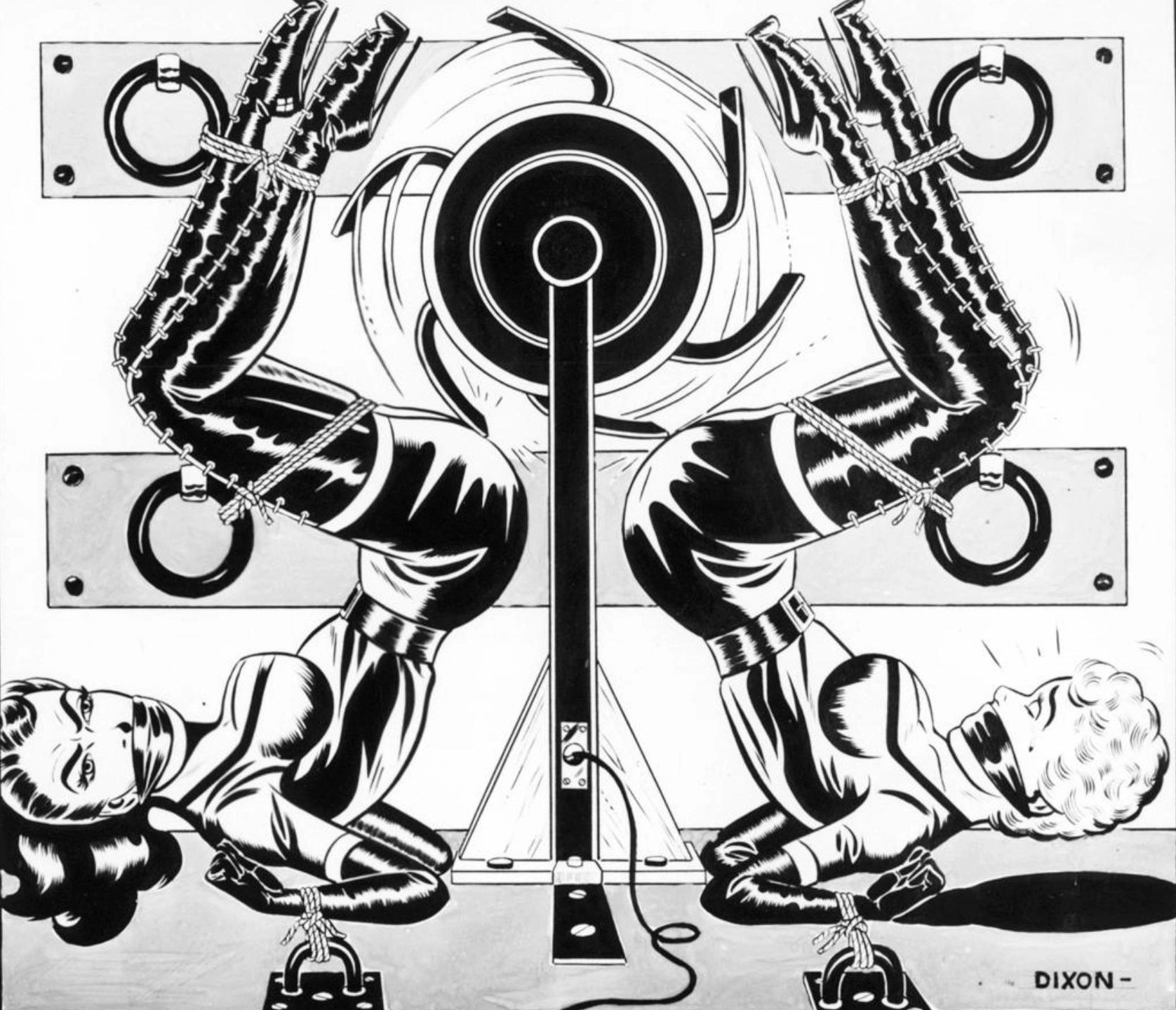
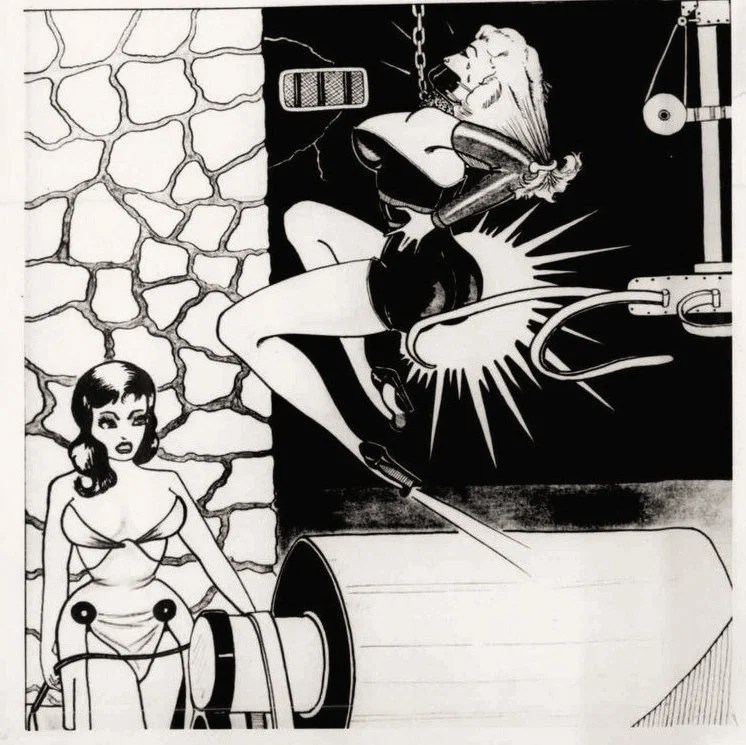

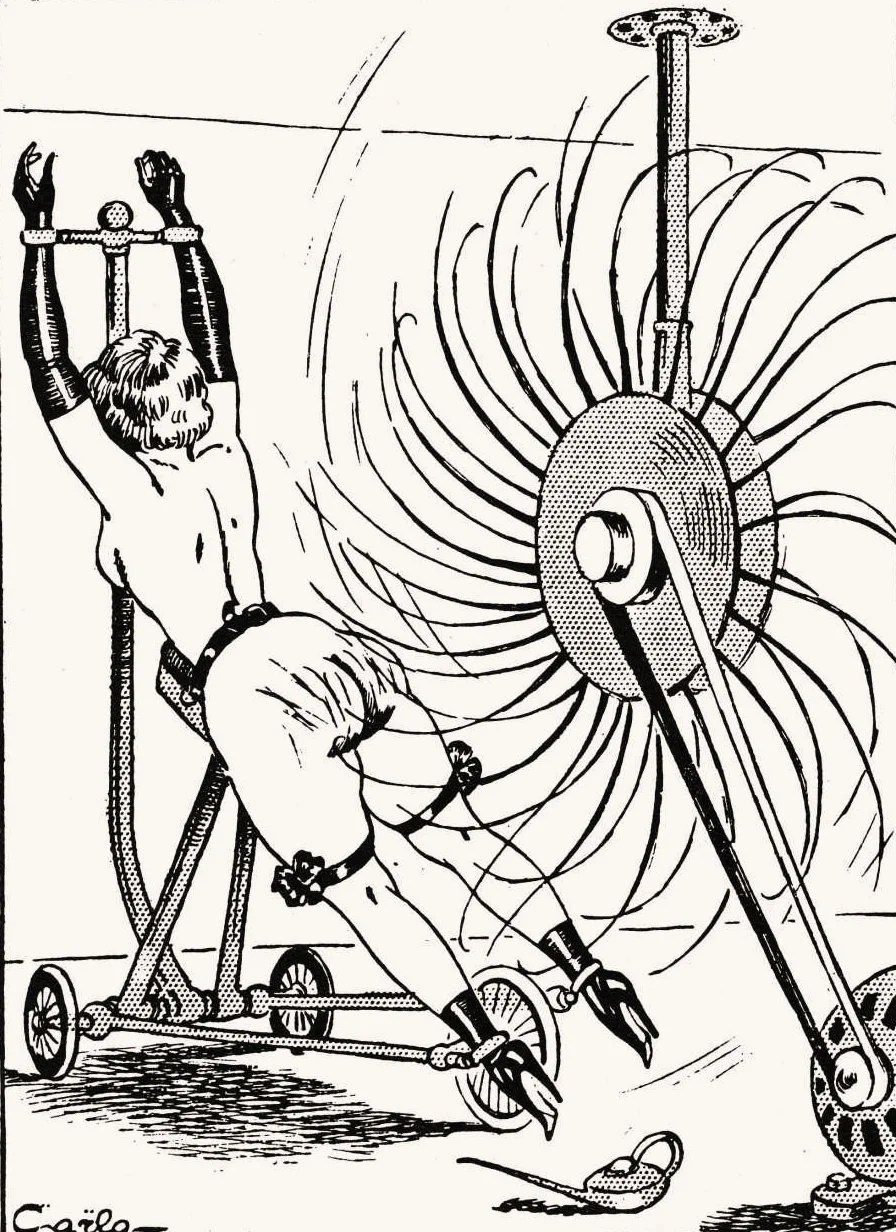


Throughout the second half of the nineteenth century, industrial-looking spanking and caning machines appeared in books and magazines, particularly in Russia and Germany. These illustrations often showed rows of offenders waiting their turn before a large mechanical apparatus fitted with paddles or rods. Whether any of these designs were ever built remains unclear, but they reveal a recurring fascination with the idea of automated discipline.


DeMoulin Brothers – Patented Machines (1900 & 1909)
The clearest examples of real, manufactured spanking machines come from DeMoulin Bros. & Co. of Greenville, Illinois. The company specialized in initiation devices for fraternal organizations and college fraternities.
In 1900 Edmund and Ulysses DeMoulin received a patent for an “Initiating Device.” In 1909 Ulysses patented the better-known “Combined Lifting and Spanking Machine” (U.S. Patent 920,837). The candidate bent forward and pulled on handles as if testing his strength. At a certain point a spring-loaded paddle swung up and struck him, often accompanied by the bang of a blank cartridge and an electric shock.
These machines were openly advertised in the company’s catalogues and sold as elaborate practical jokes rather than serious instruments of punishment. Still, they remain the earliest fully documented and commercially produced spanking machines.


Fantasies on Paper – Patient Drawings in Early Sexology
In the early decades of the twentieth century, some psychotherapists and sexologists asked patients who spoke about sadomasochistic desires to draw their fantasies. A number of these drawings later appeared in semi-scientific publications, often without the patient’s clear consent.
Among the best-known examples are the works associated with Helga Bode. In the 1920s she produced a large body of spanking and related drawings. Several of these were published in the early 1930s in books by the German sexologist Ernst Schertel, including Der Flagellantismus als literarisches Motiv and Der Komplex der Flagellomanie. It is widely believed that Bode (or a patient using that name) had entrusted the drawings to her psychotherapist, who then passed them on for publication.
What makes these images particularly striking is the presence of spanking machines in some of the fantasies. Many of the patients would have had little or no access to illustrated books, magazines, or popular media depicting such devices. Yet the motif of a mechanical apparatus that delivers punishment appears spontaneously in their drawings, sometimes rooted in childhood or adolescent daydreams.
These patient illustrations form a quiet but revealing chapter in the history of the spanking machine: not as an engineered object or a satirical invention, but as an image that could arise independently in the imagination.
Closing Note
From Bentham’s rational proposal to satirical steam engines, institutional experiments, and fraternity prank devices, the spanking machine occupied a peculiar place in the late nineteenth and early twentieth centuries. Most remained ideas or short-lived experiments. Only later, in the context of consensual BDSM, would mechanical spanking devices reappear in a completely different spirit.
This overview is intended as a companion to the earlier article History of Sex Machines.
Further Reading & Sources
- The Rationale of Punishment – Jeremy Bentham (1830)
- The Steam Cat – Punch magazine, 17 September 1859 (“The Steam Cat”)
- Spanking By Electricity -The New York Times, 14 February 1898
- Star Tribune (Minneapolis), 24 October 1903
- Sunday Oregonian, 13 December 1903
- Pustertaler Bote, 16 October 1903
- DeMoulin Bros. catalogues and U.S. Patents 654,611 (1900) & 920,837 (1909)
- Ernst Schertel – Der Flagellantismus als literarisches Motiv and Der Komplex der Flagellomanie (early 1930s)