In the shadows of early 20th-century America (where moral codes were ironclad and everyday life often masked deeper truths) one photographer captured two worlds: the polished portraits of the respectable middle class and the intimate, clandestine moments of a marginalized underworld. William Goldman, a name that whispers of discretion and human vulnerability, deserves a place in the archives of erotic photography. His work, long concealed from public view, offers a rare glimpse into an era of hypocrisy and survival.
He never made us feel like we were being sold. He just wanted to see us as we were—tired, real, alive.
Anonymous recollection attributed to one of Sallie Shearer’s women, preserved in a private collector’s notes
A Respectable Life in Reading, Pennsylvania
William I. Goldman, known as Billy (1856–1922), was a well-regarded commercial photographer in Reading, Pennsylvania. A Freemason and community figure, he documented the lives of local families, businessmen, and everyday citizens. Images that embodied the façade of the American success story.
His studio, centrally located in the heart of town, stood as a beacon of normalcy. Yet just blocks away, in the nearby brothel run by Sallie Shearer, Goldman revealed an entirely different side of society. This double life (by day a pillar of the community, by night a silent witness to forbidden desires) makes Goldman a compelling figure. His work echoes that of contemporaries like E.J. Bellocq, the New Orleans photographer who similarly immortalized the prostitutes of Storyville with tenderness and detachment. Goldman, however, operated in a smaller, more suffocating world, where gossip and reputation could destroy a life.
The Secret Collection: Intimate Portraits from the Brothel
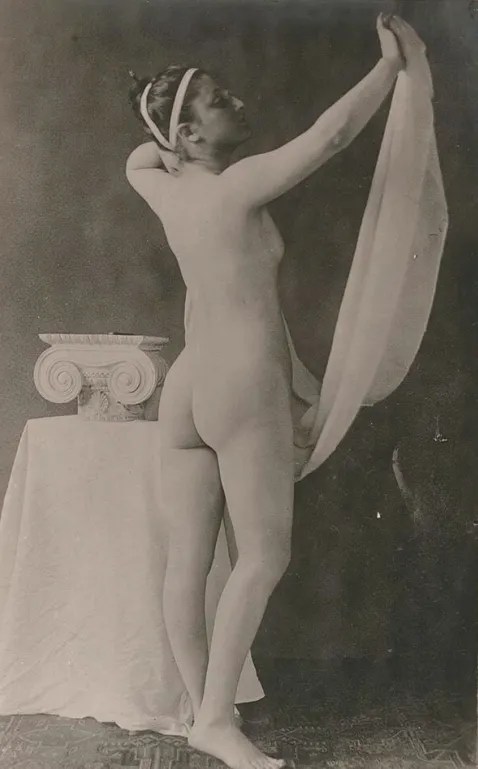
Goldman’s most intriguing work remained a closely guarded secret for nearly a century: a series of photographs of the prostitutes in Sallie’s brothel. Taken with the consent of his subjects but without commercial intent, these images were meticulously mounted into private albums. They show women in their most unguarded moments: nude, relaxed, sometimes with a touch of humor or melancholy, far removed from the sensationalism that would later define erotic photography.
The photographs, which only surfaced in the early 21st century, exude an atmosphere of quiet intimacy. The women are not posed for titillation; they lounge on beds, smoke cigarettes, or gaze directly into the lens with a mix of defiance and weariness. Goldman’s approach was clinical yet compassionate, as if documenting a hidden ethnography rather than exploiting his subjects.




Legacy in Shadows
Goldman died in 1922, his secret albums passing through private hands until their rediscovery decades later. Unlike Bellocq’s scratched negatives or the staged glamour of later pin-up eras, Goldman’s images are raw, unfiltered, and deeply human. They challenge the viewer to confront the thin line between respectability and vice and the photographer who walked it without judgment. His work reminds us that behind every polished portrait hangs a shadow world, and sometimes, the truest photographs are the ones never meant to be seen.