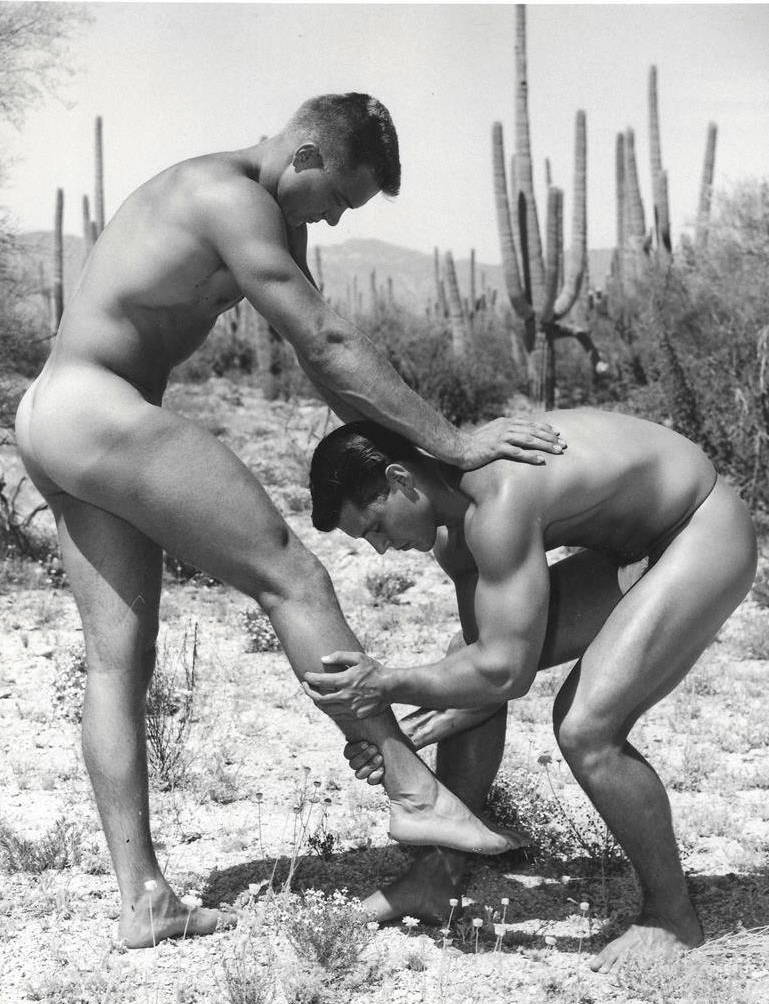
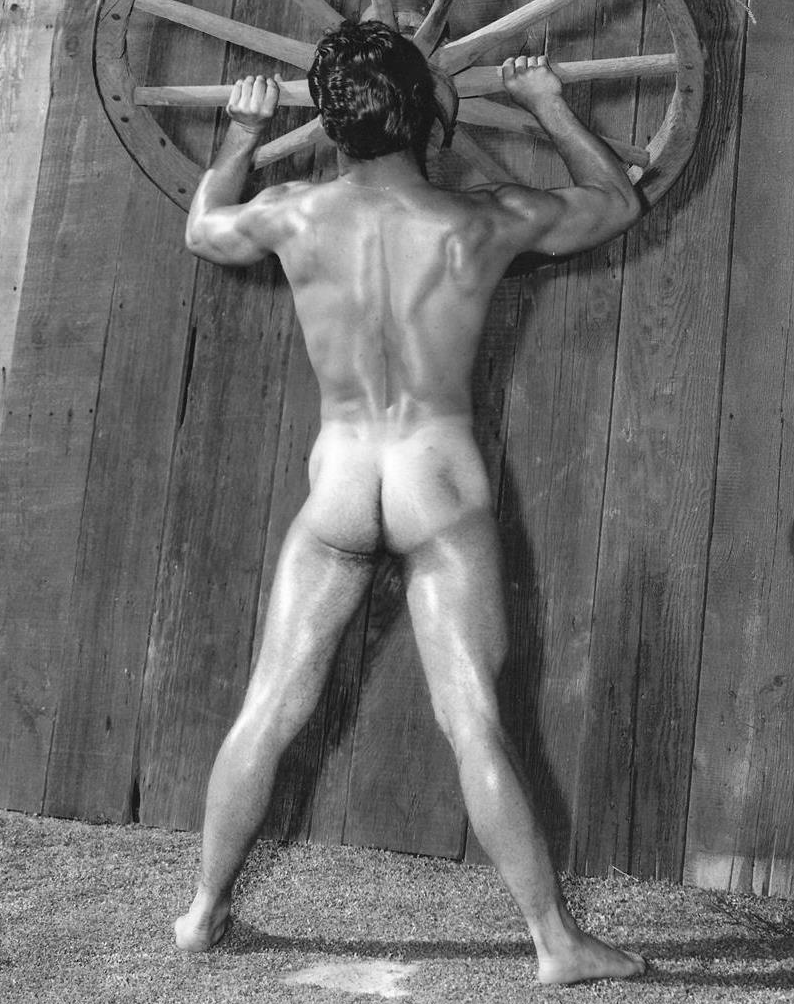
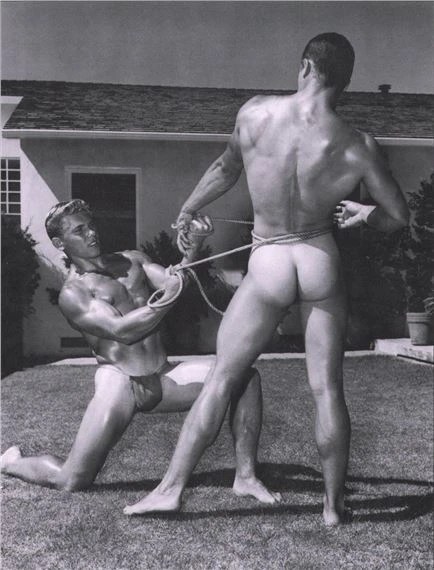
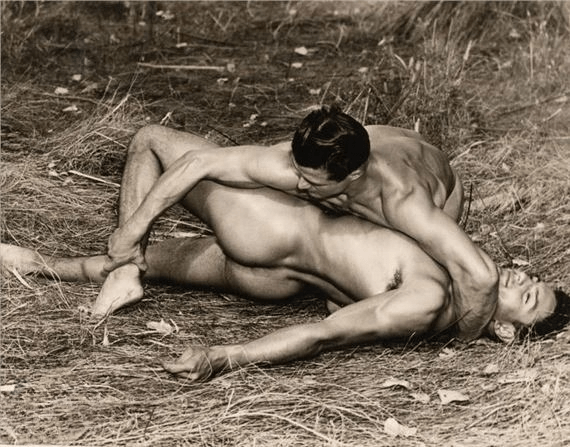
Born July 7, 1909, in the austere plains of Alliance, Nebraska, Bruce Bellas began as a chemistry teacher, stirring formulas by day while his imagination churned with visions of bodies in motion. By 1947, he traded the chalkboard for the raw pulse of California’s Muscle Beach in Venice, where bodybuilders glistened under the relentless Pacific sun. What began as competition shots evolved into something far bolder: a visual rebellion that captured the male form with an intimacy that defied the era’s moral straitjacket. Bellas, soon Bruce of Los Angeles, found his calling not in documenting muscle, but in sculpting desire itself.
I photograph what the eye dares not linger on
Bruce Bellas
A Coded Art: Defying the Censors
From his Long Beach studio on Kensington Road, Bellas crafted images that danced on the edge of legality: full-frontal nudes posed with theatrical precision, leather straps glinting, bodies arched like Greek statues reborn in a homoerotic glow. In the 1950s, when postal inspectors hunted “obscene” mail, he outwitted them with cunning, crisscrossing the country with prints stashed in his car, delivering to eager clients in shadowed hotel rooms. His 8mm films, like Cowboy Washup (1962), spun fleeting narratives—water tracing muscled contours, a nod to both power and vulnerability. “I photograph what the eye dares not linger on,” Bellas declared, a quiet creed for his art’s delicate balance of exposure and restraint. His 1956 magazine, The Male Figure, crystallized this vision: glossy pages of models like Scotty Cunningham, their forms both mythic and intimate, whispering to a community forced to speak in code. Bellas’s influence ripples through the stark intimacy of Mapplethorpe and the narrative sweep of Weber, yet he remained a shadow-dweller, his work a private communion until his death in July 1974, at 65, while traveling in Canada with a muse. His archive (over 2,000 negatives) stands as a monument to a time when every frame was a risk, every pose a revolution.
Bellas’s legacy bridges hidden desire and eternal light, a testament to art’s power to transcend suppression.