Let’s go on a journey through six provocative prints by John Smith (1652–1743), a renowned English mezzotint engraver who left a legacy of intricate prints that blend satire, sexuality, and power dynamics. Known for reproducing works by masters like Rubens and creating original pieces, Smith’s art from the late 17th and early 18th centuries subtly echoes modern BDSM themes: dominance and submission (D/s), bondage, sadomasochism (SM), humiliation, and niche fetishes like watersports or knife play.
The Cully Flaug’d (c. 1680‑1700) – Mezzoprint by John Smith after Marcellus Laroon
This print shows a young woman striking an older man’s buttocks with a bundle of twigs as he leans over a chair, grinning back at her. Her lifted skirt reveals her genitals, and a satirical poem below addresses impotence and ‘arousal.’ It continues the Restoration-era tradition of erotic satire. Below the sketch this text can be read:
What drudgery’s here, what Bridewell‑like correction!
To bring an old man, to an insurrection.
Firk on fair lady, flaug the fumbler’s thighs,
Without such conjuring the devil will not rise.
(“Flaug” is a variant of “flog.” The poem mocks the “labour” required to make the “devil”, a euphemism for the penis “rise.”)
The work satirizes impotence, marital failure, and the role of prostitutes as providers of sexual “help.” “Cully” refers to a naïve man who is deceived (often sexually), and the scene plays on the irony of a laborious “correction” meant to arouse desire. Supposedly the print was connected to this phrase: Of late years there’s a neat invention, called Flogging, invented on purpose to pleasure Old Fumblers, published in Tell‑Troth’s Knavery of Astrology (1680), a satirical pamphlet published in England in 1680. Here “Old Fumblers” is slang for impotent older men, a term already circulating in folk songs and dictionaries of the time (e.g., defined in the 1699 A New Dictionary of the Canting Crew as “an unperforming husband, one that is insufficient”).

Central to this is flogging as a means of sexual stimulation, a core element of impact play in BDSM. The woman is dominant, the man submissive and humiliated, with themes of age play (the ‘fumbler’ as an older man) and voyeurism. The poem’s focus on ‘conjuring’ lust through pain parallels modern edging or tease-and-denial techniques, linking punishment explicitly to eroticism.
Friar Whipping a Nun (c. 1683‑1729) – John Smith
This mezzotint (by John Smith) depicts a monk in a habit raising a whip above a kneeling woman, her buttocks exposed as she clasps her hands in a prayer-like pose. An open book on a shelf in the background suggests a monastic setting. Historically, this reflects flagellation as a religious penance practice, but Smith’s rendition carries an erotic undertone. The woman is identified as Mrs. Russell, a noted courtesan, aligning the print with 17th-century erotic satire.

The image foregrounds corporal discipline within a religious context, turning a sacred hierarchy upside down. The monk embodies dominance, delivering punishment, while the woman’s submissive posture hints at humiliation and pain as a form of ‘purification’ or pleasure. In modern BDSM, this mirrors roleplay scenarios like ‘priest and penitent,’ where power imbalance and consensual punishment are central.
Tarquin and Lucretia (1688) – Mezzoprint by John Smith after Willem de Ryck
John Smith’s mezzotint after Willem de Ryck dramatizes the legendary rape of Lucretia by Tarquin. The composition captures the violent thrust, with Lucretia’s clothing torn and her pearl necklace shattered.

The work visualizes rape- knife- and fear-play, where weapon threats feature in consensual scenes. (always staged consensually in modern kink) by portraying non‑consensual violence. The power imbalance and physical vulnerability echo bondage and submission, with a dark edge. The intense physical struggle, broken garments, and Lucretia’s anguished expression highlight pain, humiliation, and loss of control are elements that many consensual BDSM scenarios deliberately recreate under strict negotiation and safewords.
Xanthippe Riding on the Back of Socrates with a Whip (c. late 17th c.) – Mezzoprint by John Smith after H.G.
This satirical mezzotint portrays Xantippe, Socrates’ wife, riding naked (save for a loose cloth) on his back, wielding a whip and reins as he crawls on all fours. A scholar reading in the background adds a philosophical context. Historically, it mocks Socrates’ marriage, drawing on anecdotes of his domineering wife.
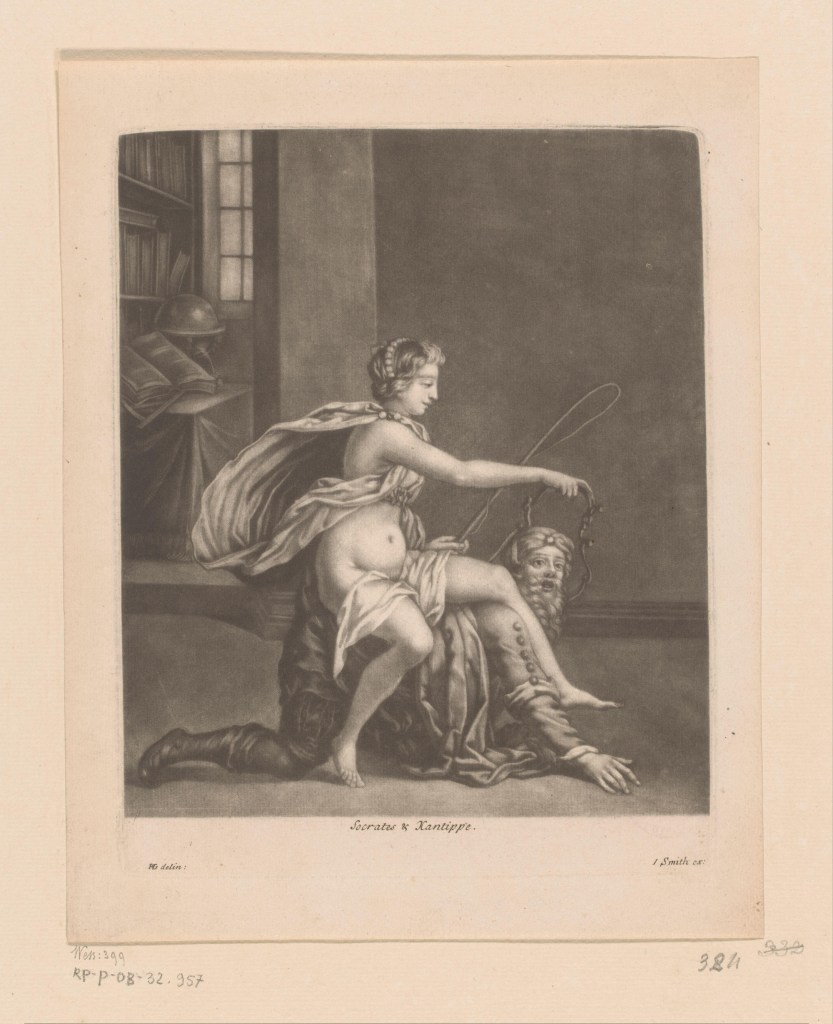
This is a clear depiction of femdom (female dominance), with Xantippe exercising control through humiliation and physical dominance, incorporating pony play (treating a human as an animal) and whipping. The reins symbolize bondage and control, while Socrates’ submission satirizes male authority. In BDSM, this reflects role reversal and degradation play, where humiliation fuels erotic pleasure, marking an early exploration of gender dynamics.
Half‑Naked Woman Pees into a Bowl – Mezzoprint by John Smith
This intimate print shows a woman in elegant attire squatting, her skirt lifted, urinating into a bowl. Her serene expression, framed by a cap, contrasts with a table in the background. Rooted in 17th-century ‘toilet scenes,’ it carries voyeuristic or humorous intent.

This relates to watersports (golden showers), a fetish involving urination in humiliation or dominance contexts. The woman’s exposure and vulnerability suggest exhibitionism or objectification, which in BDSM can extend to controlled bodily functions. Historically, it reflects taboos around physicality, now embraced in modern kink as empowerment or play.
Roman Charity (c. 1683‑1729) – Mezzoprint by John Smith after Peter Paul Rubens
Based on a painting by Peter Paul Rubens, this print shows a young woman (Pero) breastfeeding her imprisoned father (Cimon), who lies chained in a cell. The composition is intimate and dramatic, with chains and straw emphasizing his vulnerability. Rooted in Roman mythology, it symbolizes filial piety, but Smith’s mezzotint highlights the physical closeness and dependency.

While the narrative is traditionally read as filial piety, the visual focus on the exposed breast and the act of feeding can be interpreted as sensual caretaking—a cornerstone of care‑giver/submissive dynamics in kink. The image evokes feeding fetish and body‑exchange motifs, where nourishment becomes a vehicle for erotic power.