
Thomas Rowlandson ( July 1757 –1827) was an English artist and caricaturist of the Georgian Era, noted for his political satire and social observation. Rowlandson was a prolific artist and printmaker. He produced both individual social and political satires. He also created a large number of illustrations for novels, humorous books, and topographical works. Like other caricaturists of his age such as James Gillray, his caricatures are often robust or bawdy. Rowlandson also produced highly explicit erotica for a private clientele; this was never published publicly at the time and is now only found in a small number of collections.
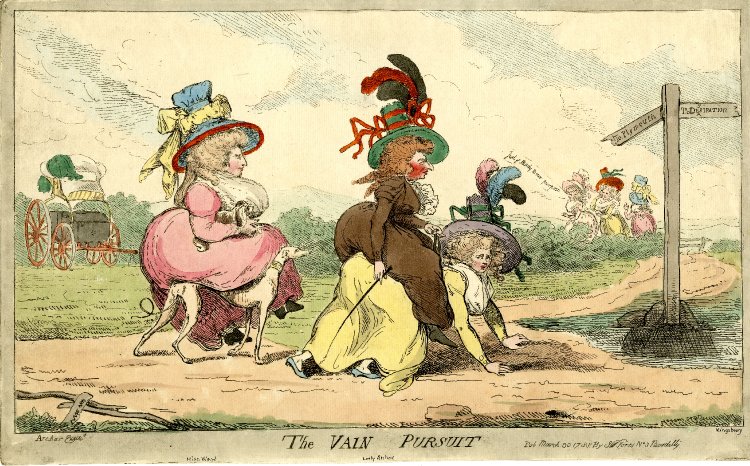
- The illustration depicts a woman driving a phaeton, a lightweight, open carriage popular in the 18th and early 19th centuries. Phaetons were associated with masculine traits like courage and boldness, and driving one was seen as a mark of elite masculinity. Published in 1785 by William Humphrey, this print humorously portrays a woman in a phaeton. She is escaping a group of pursuing women. It exemplifies how phaetons and their drivers were used in satire to comment on gender roles and societal norms of the time.
- This engraving published by S.W. Fores on May 10, 1787, depicts two women about to fight, with a third woman watching. The caricature is typical of Rowlandson’s style. He was known for his satirical portrayals of English social life in the late 18th and early 19th centuries. The title and image suggest commentary on women’s roles in society and the rise of female sports or entertainment during that era.
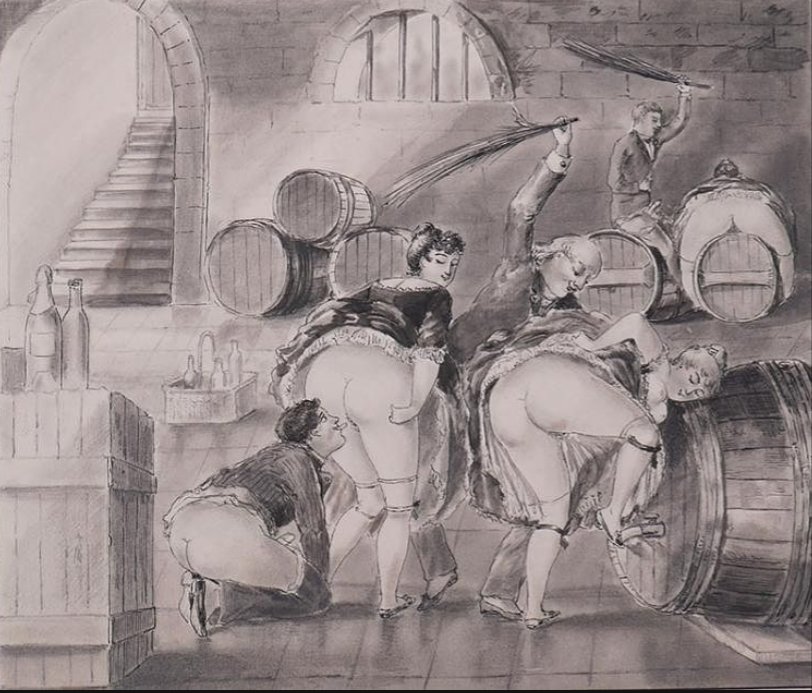
- This hand-colored drawing, created with pen and ink, watercolor over pencil, depicts figures in a setting resembling a wine cellar or storage room with barrels. The suggestive scene, featuring figures in revealing clothing or poses, is characteristic of erotic art from the period.
- This artwork (1799), a watercolor and pencil drawing, depicts a harem scene. It shows a man observing a group of naked women, characteristic of the satirical and often erotic themes in Rowlandson’s work.