James Gillray (1756–1815) was a British caricaturist and printmaker, widely regarded as the father of the political cartoon. Born in Chelsea, London, he trained at the Royal Academy Schools and initially worked as an engraver before finding his calling in satirical prints. His sharp-witted, often provocative etchings targeted political figures, royalty, and social mores of late 18th- and early 19th-century Britain, blending grotesque humor with meticulous artistry. His works, frequently published by Hannah Humphrey, with whom he lived for much of his career, gained a wide audience through shop displays and were collected by figures like the Prince of Wales.
Gillray’s art occasionally explored themes of dominance, submission, and corporal punishment, reflecting the era’s fascination with such imagery in both satire and erotica. Notably, his 1785 etching depicting Dr. Richard Busby, the Westminster School headmaster known for strict discipline and the use of the rod, exaggerates these traits to critique authoritarian education. Other works, like Fashionable Contrasts (1792), subtly hint at power dynamics through exaggerated physicality, while Ci-devant Occupations (1805) portrays risqué, voyeuristic scenes with implied dominance, aligning with the period’s underground interest in flagellation literature. These elements, though not central to his oeuvre, tapped into Georgian society’s blend of satire and taboo, showcasing Gillray’s ability to push boundaries.
His later years were marred by declining mental health, leading to his death in 1815.

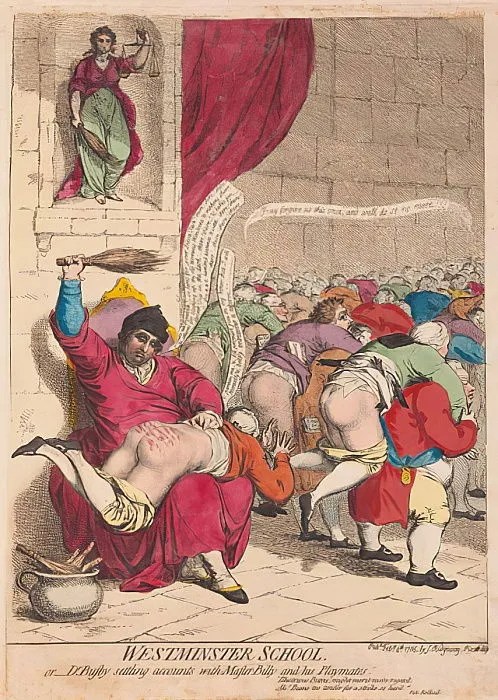


- This etching was created was published on February 4, 1785. The work depicts Dr. Richard Busby, the famous schoolmaster of Westminster School, who was known for his strict discipline and use of the rod.
- A handcolored version of the same art as shown in image 1.
- A representation of the horrid barbarities practised upon the nuns by the fish-women, on breaking into the nunneries in France. Created in 1792.
- This image shows “Discipline à la Kenyon”, a satirical print dated March 25, 1797.
The print mocks Lord Chief Justice Kenyon, who was known for his stern attitude towards gambling, particularly the card game Faro. The image shows Kenyon beating a woman symbolizing gambling with a broom, while in the background is a pillory and a sign with “FARO’S DAUGHTERS BEWARE”.
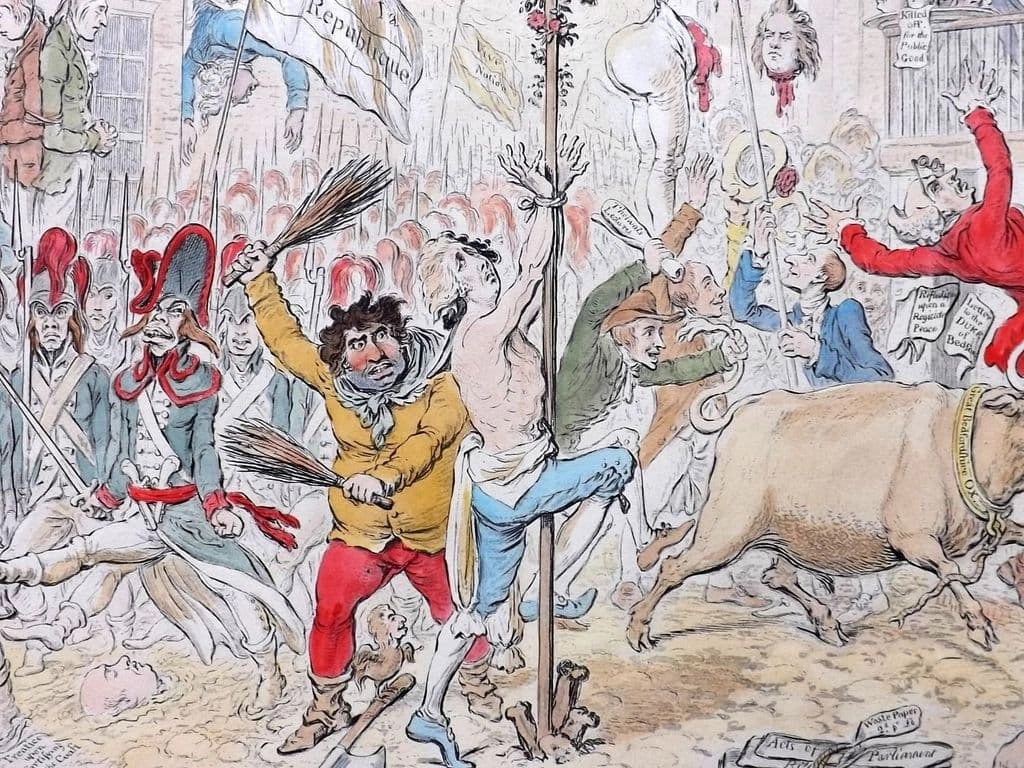
The work is a commentary on social mores and the authorities’ attempts to combat gambling and other ‘vices’ in late 18th century England. - This print from 1796 is a satire on the opposition and the possible consequences of a French invasion of England.It depicts a chaotic scene with elements of the French Revolution, such as a freedom tree and the execution of figures.